February 11, 2026
Why Diagnostic Labs Need Leaders, Not Just Managers
In the last three decades, diagnostic laboratories in India have undergone a remarkable transformation. What began as small standalone facilities has evolved into large corporate networks.
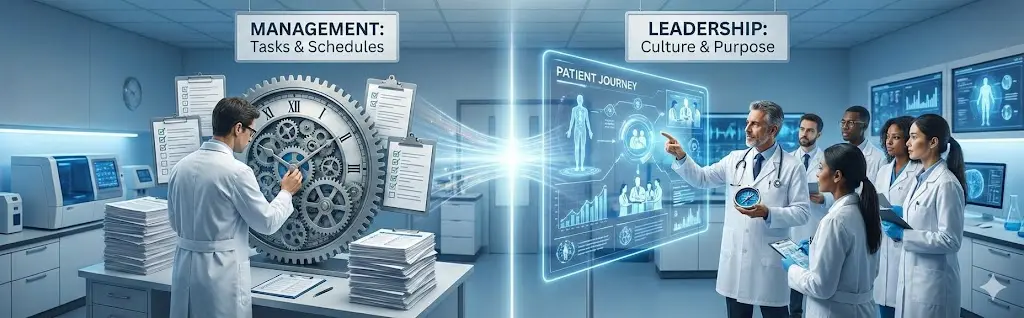
Yet many of these organizations still operate with a management mindset rather than a leadership one. The difference is profound: managers maintain systems, leaders transform them. Managers focus on efficiency, leaders focus on purpose. Managers handle the present, leaders build for the future.
The diagnostic industry today faces challenges that require leadership: integrating AI and digital pathology, navigating consolidation through mergers and acquisitions, building quality systems that scale, and developing the next generation of laboratory professionals.
Why the Difference Matters in a Laboratory
A well-managed laboratory runs on schedule. Samples are logged, analysers are calibrated, rosters are filled, and reports go out on time. All of this is essential, and none of it is easy. But a laboratory that is only managed tends to stand still. It repeats what worked yesterday, even as clinical expectations, technology, and patient needs move forward around it.
Leadership is what allows a laboratory to move with them. A leader asks why a process exists, not just whether it was followed. A leader notices when a quality indicator is drifting before it becomes a failure, and treats every error as a question about the system rather than an accusation against an individual. Above all, a leader keeps the whole team connected to the reason the laboratory exists: every result is a decision about a patient.
What Laboratory Leadership Looks Like
In my experience, effective laboratory leaders share a handful of habits:
- They set a clear direction and explain it, so that every technician understands how their bench connects to patient care.
- They build quality into culture rather than inspecting it in at the end.
- They engage with clinicians, listening to what the people using the reports actually need.
- They make difficult decisions on investment, staffing, and priorities with both clinical and commercial consequences in view.
- They develop people deliberately, because a laboratory can only grow as fast as its next generation of leaders.
None of these habits replace good management. They sit on top of it. The strongest laboratories have both: disciplined systems and people at the top who know where those systems should take them.
The Challenges Ahead Demand It
Consider the decisions diagnostic organizations face today. Adopting AI and digital pathology is not a purchasing decision; it changes workflows, roles, and the way pathologists interact with images and data. Mergers and acquisitions bring together teams with different cultures, standards, and loyalties, and integration succeeds or fails on trust long before it succeeds or fails on systems. Quality systems that work in one laboratory must be rebuilt to hold across a network. Each of these is, at heart, a leadership challenge.
A management mindset will try to solve them with procedures alone. A leadership mindset recognizes that procedures only work when people believe in them.
Developing Leaders from Within
Leadership in laboratory medicine is rarely taught formally. Most of us learned it by watching others, by making mistakes, and by taking on responsibility before we felt ready. Organizations can do much better than leave this to chance. Structured mentorship, exposure to operational and financial decisions, and the freedom to lead small improvement projects all help capable professionals grow into the leaders their laboratories will need.
Organizations that invest in leadership development, not just management training, are the ones that will define the next era of diagnostic medicine in India and beyond.
If your organization is working through this transition, I write more about it in career pathways in laboratory medicine, and you can read about how I support teams through mentorship and leadership training and laboratory operations consulting.