August 20, 2026
The Future of Diagnostic Medicine: Where Healthcare Is Heading
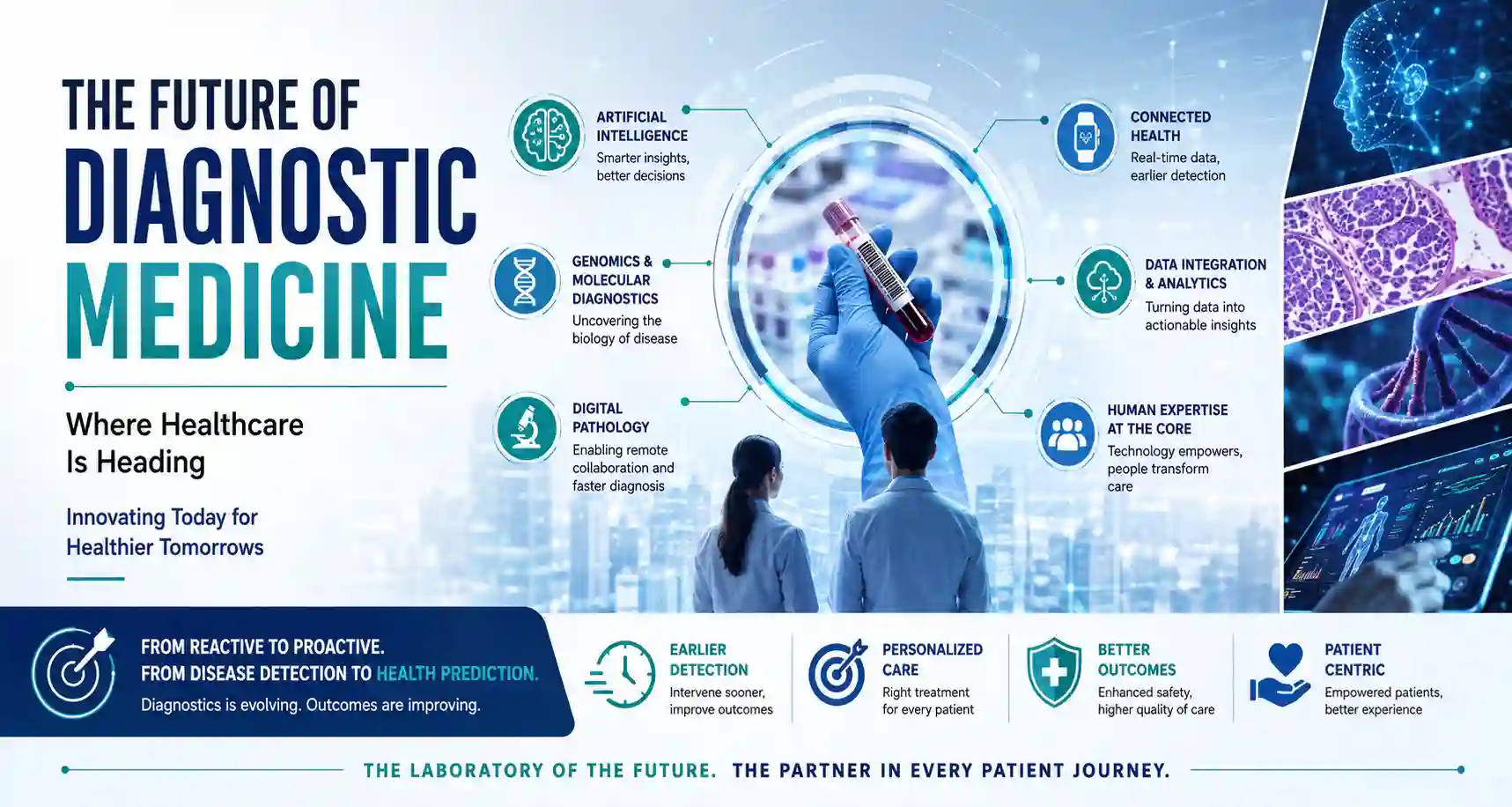
How innovation, data, and human expertise are shaping the next generation of healthcare.
Diagnostic medicine is undergoing one of the most significant transformations in its history. For decades, laboratories have been the silent engines of healthcare, providing clinicians with the information needed to diagnose disease and guide treatment. Today, however, diagnostics is evolving from a service that confirms disease to one that predicts, personalises, and even prevents it.
Advances in artificial intelligence, digital pathology, molecular diagnostics, genomics, wearable health technologies, and real-time data analytics are redefining how diseases are detected and managed. Patients are increasingly becoming active participants in their own healthcare through remote monitoring, mobile health applications, and home-based diagnostic devices, while clinicians now have access to unprecedented volumes of clinical and molecular information to support decision-making.
At the same time, laboratories are transitioning from isolated testing facilities into digitally connected hubs that integrate pathology, radiology, genomics, and clinical information to provide a more comprehensive understanding of each patient's health. The future of diagnostic medicine is therefore not about replacing traditional laboratory science but about expanding its role: from identifying illness to predicting risk, enabling earlier intervention, and supporting truly personalised healthcare.
The Technologies Driving Change
Several emerging technologies are driving this transformation. Artificial intelligence is helping laboratories prioritise critical cases, detect subtle abnormalities, improve workflow efficiency, and assist pathologists in interpreting increasingly complex data. Digital pathology enables remote consultation, faster collaboration, and improved education, while molecular diagnostics and next-generation sequencing are uncovering the biological mechanisms of disease with remarkable precision.
Liquid biopsy offers the possibility of diagnosing and monitoring certain cancers through a simple blood sample, and wearable devices continuously generate physiological data that may identify disease long before symptoms appear. Cloud computing, interoperable electronic health records, and advanced bioinformatics are allowing healthcare professionals to combine laboratory findings with imaging, genetics, and clinical history to generate more accurate and individualised diagnoses.
Why Human Expertise Still Matters
Yet despite these remarkable advances, technology alone cannot define the future of diagnostics. High-quality specimens, validated laboratory processes, robust quality assurance, ethical data governance, cybersecurity, and skilled healthcare professionals remain essential to ensuring that innovation translates into better patient outcomes.
The laboratories that thrive in the coming years will be those that successfully integrate cutting-edge technology with scientific rigour, multidisciplinary collaboration, and a relentless commitment to quality. These are the same principles that guide my diagnostics consulting work with laboratories across India today.
The Laboratory as an Intelligent Clinical Partner
Looking ahead, the laboratory of the future will be far more than a place where tests are performed; it will become an intelligent clinical partner that contributes to every stage of patient care. Diagnostic professionals will increasingly collaborate with clinicians, radiologists, geneticists, data scientists, and artificial intelligence platforms to deliver integrated reports that not only identify disease but also predict progression, recommend targeted therapies, and monitor treatment response over time.
Throughout my career, I have witnessed laboratory medicine evolve from manual microscopy and isolated reporting to an era of automation, digital connectivity, and precision diagnostics. Yet one principle has remained constant: every technological breakthrough is meaningful only if it improves patient care.
The future of diagnostic medicine will not be defined by machines replacing healthcare professionals but by technology empowering them to make faster, more accurate, and more informed clinical decisions. As diagnostics continues to move from reactive disease detection toward proactive health management, laboratories will play an increasingly central role in delivering safer, smarter, and more personalised healthcare.
The future has already begun. Those who embrace innovation while preserving the principles of quality, collaboration, and patient-centred care will shape the next generation of medicine.