March 2, 2026
What I Learned Building Diagnostic Networks Across India
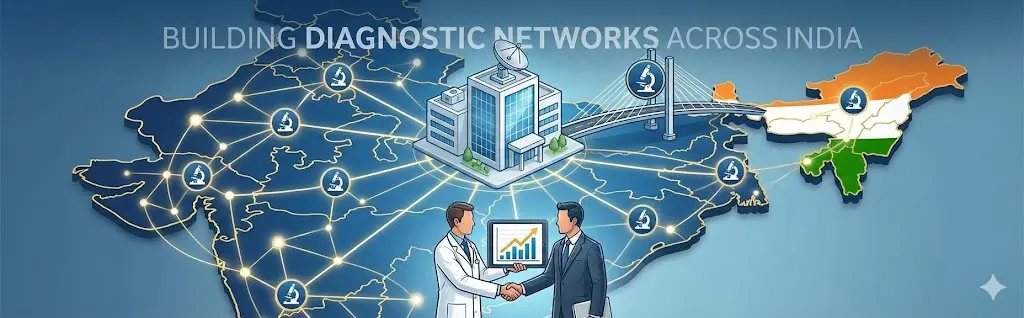
Over three decades in diagnostic laboratory medicine, I have had the privilege of working with standalone laboratories, large corporate diagnostic chains, and hospital-based services across India.
The journey of building diagnostic networks taught me that success lies not just in clinical excellence, but in understanding the unique challenges of each market: from metro cities with intense competition to tier 2 and 3 towns where access itself is the primary concern.
Key lessons from this experience include the importance of standardizing quality systems before scaling, building local leadership talent rather than relying solely on central management, and creating operational frameworks flexible enough to adapt to regional needs while maintaining consistent clinical standards.
Lesson One: Standardize Before You Scale
It is tempting to grow quickly: open more collection centres, add more satellite laboratories, extend the test menu. But every new site multiplies whatever is already in place, including its weaknesses. If quality systems, documentation, and reporting standards are not robust at the centre, expansion simply spreads inconsistency across a wider area.
Before scaling, a network needs a common foundation: shared SOPs, harmonized test methods and reference ranges, a single approach to internal quality control and external quality assessment, and an information system that lets leadership see performance across sites. These investments are rarely glamorous, but they are what allow a clinician in one town to trust a report exactly as much as a clinician in the next.
Lesson Two: Build Local Leadership
No central team, however capable, can run every site from a distance. Networks that depend entirely on head office tend to react slowly and lose touch with local realities. The networks that work best develop strong leaders at each site: people who understand the central standards and also understand their own community, clinicians, and staff.
Developing this talent takes time. It means training, mentoring, and trusting people with real responsibility. In my experience, it is one of the best investments a growing network can make.
Lesson Three: Be Consistent in Standards, Flexible in Operations
India is not one market. A metro laboratory competes on speed, test menu, and convenience. A laboratory in a tier 2 or tier 3 town may be the only reliable option for many kilometres, and its challenges are logistics, staffing, sample transport, and affordability. Applying an identical operating model everywhere rarely works.
The answer is to hold clinical and quality standards constant while allowing operational models to adapt: collection schedules, transport routes, staffing patterns, and community engagement that suit each region. Consistency belongs in the result; flexibility belongs in how you deliver it.
Lesson Four: Integration Is About People
When networks grow through acquisition or partnership, the technical work of integration, aligning equipment, LIS, and processes, is only half the task. Each team brings its own culture and habits. Integration succeeds when people understand why change is happening, see that their experience is respected, and feel part of something larger. Without that, even well-designed systems struggle to take hold.
Why It Matters
The most rewarding aspect has been witnessing how improved diagnostic access directly translates to better patient outcomes in underserved areas, proving that healthcare infrastructure investment delivers both social and business value.
If you are planning network expansion, standardization, or integration, you can read more about how I work on strategic leadership and growth and laboratory operations consulting.